
At eight o'clock the river crowds begin to thin, and the smell of the evening changes from incense and candle wax to garlic, shallots and hot oil. The tables along the side streets fill. Families who came down for the lanterns sit down to eat, and the people who have been selling to them all evening start thinking about dinner too. This is the hour for a proper meal, and two of the dishes the town is known for are made for it.
One is soft, pale and delicate: the white rose dumpling. The other is crisp, golden and noisy: fried wonton, piled with a sweet and sour topping. They are often ordered together, and they come from the same old, mixed kitchen of a port town where Chinese, Vietnamese and other cooking met.
The white rose
In Vietnamese the dish is banh bao banh vac. In English it is usually called white rose, and one look at a plate explains why. Each dumpling is a small round of translucent dough, pinched up around a filling and steamed so that its edges curl outwards like the petals of a pale flower. A small pink heart of shrimp shows through the middle.
The dough is made from rice flour and water, kneaded until it is smooth and stretchy, then rolled thin and shaped by hand. The filling is minced shrimp, often with a little pork and seasoning. After steaming, the dumplings are laid out on a plate and scattered with crisp fried shallots. They come with a small bowl of dipping sauce: fish sauce sweetened and soured, with slices of chilli and garlic. The texture is the point, soft and slightly springy, almost slippery, against the crunch of the shallots.
The dumplings are made by hand, and much of the work is done during the day, so by evening the kitchens are ready. Order a plate and it comes quickly.
Fried wonton
Hoanh thanh is the Vietnamese name for wonton, the folded dumpling of Chinese cooking. In Hoi An it appears in two ways. One is in soup, with wonton floating in a clear broth. The other, and the one that has become the town's signature, is fried.
The wonton are fried until crisp and golden, then arranged on a plate and spooned over with a thick topping. The topping is sweet and sour, usually made with tomato, onion and other vegetables, with shrimp or pork. It soaks a little into the edges of the fried wonton and leaves the middle crunchy. Herbs go on top. It is more like a snack plate than a dumpling dish, and it is eaten with the fingers or chopsticks, crunching and spilling.
It is a loud, cheerful dish next to the quiet white rose, which is exactly why the two are good together.
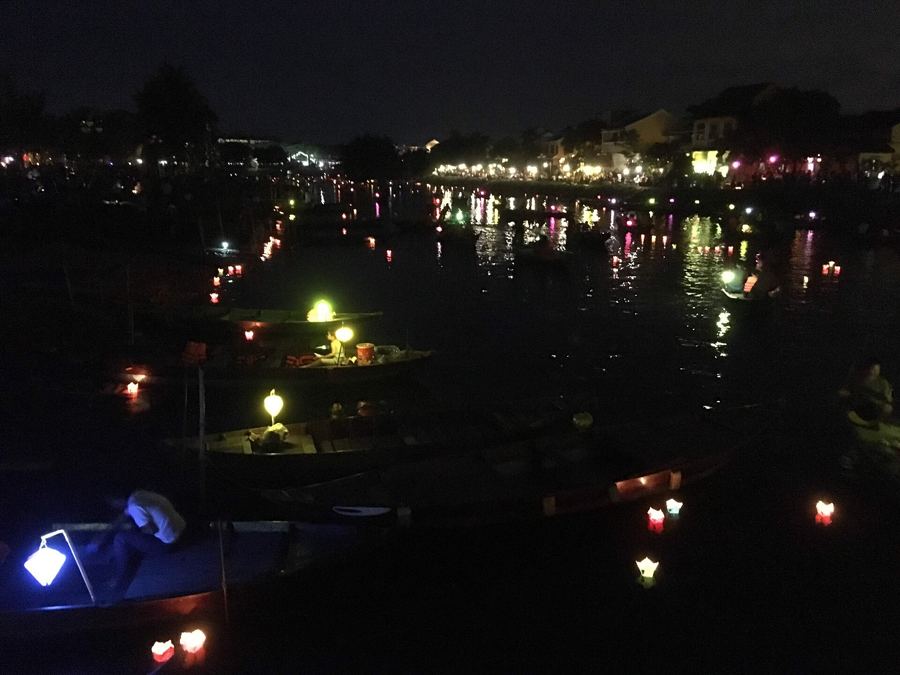 19:00Full-moon nights, when the street lights go off
Where they come from
Both dishes belong to the long history of the port. Hoi An was a trading town from the fifteenth to the nineteenth century, with large Chinese and Japanese communities alongside the Vietnamese. Dumplings and wonton are part of that Chinese inheritance, and over the centuries they have become something distinctly local. You will find wonton across Vietnam, but fried and dressed this way it is very much a Hoi An dish. White rose dumplings are rarely seen outside the town.
They are close cousins of cao lau, the noodle dish that the town claims as its own and that also carries traces of the port's mixed past. Many places that serve one serve all three, and a table of cao lau, white rose and fried wonton is a good way to taste the town in one sitting. If you want a fourth, mi Quang, the turmeric noodle of the province, is often on the same menu.

How to order, and how to eat
You can find both dishes on menus all over the Old Town, from small family places with plastic stools to restaurants with tablecloths. Look for a place busy with Vietnamese families as well as visitors. Point at what others are eating if you are unsure.
A plate of white rose is small; order one per person, or more if you are hungry. A plate of fried wonton is bigger and can be shared. Ask the price before you order if there is no menu with prices on it; prices change, so we give none.
To eat the white rose, pick up a dumpling with chopsticks, dip it in the sauce, and eat it in one or two bites. Take some of the fried shallots with each bite. The fried wonton is easiest with your fingers, or with chopsticks if you have the skill, eaten while it is hot and still crisp; wait too long and the topping softens it.
Drink iced tea, or a cold beer. The tea is often refilled without your asking.
A plate of herbs and a few slices of lime or cucumber may come to the table as well. Use them as you like: a leaf of mint or basil with a dumpling, a squeeze of lime into the sauce. Nobody will mind how you eat, as long as you eat while it is hot. White rose goes cold and firm quickly, and it is at its best in the first few minutes off the steamer.

Something sweet afterwards
After a plate of dumplings, walk off into the side streets and look out for che, the sweet soups and puddings that are sold from stalls and carts in the evening. One Hoi An speciality is xi ma, a dark, thick sweet soup made with black sesame and herbs. It is an acquired taste, earthy and slightly bitter, and it is sold from carts by street vendors in the evening. If you see it, try a small bowl.
Or keep walking towards the river, cross to the night market on An Hoi, and pick up a grilled rice paper on the way back.
What the next hour brings
By nine, the families start drifting home, and the street-food stalls take over. Plastic stools spread across the pavements, pots steam on charcoal, and the late crowd arrives. Our guide to street food after dark explains how to eat at the stalls: how to choose, how to point, and what to drink.