
The market is loud before it is light. By six o'clock the stretch of Tran Phu and Bach Dang around the old yellow market building is already full of motorbikes with baskets lashed to the back, women in conical hats hauling sacks off the pillion, and the slap of fish being tipped onto wet concrete. The rest of the Old Town is shuttered. Here, the day is two hours old.
Hoi An's central market sits at the eastern end of the Old Town, where Tran Phu meets the river. The front of it is the yellow hall with its name painted high on the gable, facing a small square with a pavilion. Behind and around that hall the market spreads in every direction: down to the riverbank, along the lanes, under awnings and tarpaulins, and into a long covered food hall where the breakfast cooks work.
Come early. By eight the light is hard, the produce has been picked over, and the tour groups arrive. At six the market is still doing what it is for, which is feeding the town.
The fish landing
Start at the river side. The boats that came down the Thu Bon and in from the coast before dawn tie up along the bank behind the market, and the catch goes straight from the hull onto the ground. This is the wettest, busiest and most interesting part of the market, and it is where you should be in the first half hour.

The sellers squat on low stools behind wide plastic tubs and steel trays: prawns still twitching, small silver fish, squid, clams, crabs bound with string, and larger fish laid out in rows on the tiles. Water runs everywhere. Buyers, mostly women shopping for the household or for a food stall, bend over the tubs, pick things up, weigh them in the hand and haggle hard and fast. Scales come out, plastic bags are knotted, money changes hands, and the buyer is gone.
Wear shoes you do not mind getting wet, and keep to the edges. The floor is slick, people move quickly with heavy loads, and nobody here has time to step round a visitor. If you want a photograph of a seller, ask with a gesture first and accept a no.
Herbs, greens and the street stalls
Walk back up from the river and the smell changes from fish to green. Along the lanes beside the market hall, sellers set out flat round baskets of vegetables and herbs right on the pavement: bunches of morning glory, long beans, bitter melon, gourds, cucumbers, bundles of spring onion, and a dozen kinds of leaf you may not be able to name.

This is where the leaves for the town's noodle bowls come from. Cao lau and mi Quang are served with a nest of raw greens, and banh xeo, the crisp rice-flour pancake, is eaten wrapped in lettuce with a handful of herbs. Much of that produce is grown a few kilometres north at Tra Que and the other vegetable villages around the town, cut the evening before or in the dark, and sold here at dawn.
Look closely and you will see the herbs sorted by kind: rau ram with its pointed leaves, purple-backed tia to, small-leaved basil. Most sellers will let you smell a sprig if you ask. They are selling to cooks, not to visitors, so do not expect anyone to explain; just watch what the regulars buy.

Inside the hall
The old market building itself is cooler and dimmer. Under the roof there are stalls of dried goods: rice in open sacks, dried shrimp and squid, beans, spices, sauces in plastic bottles, and the dense smell of fermented fish. Further in there are household goods, cloth, and in places the counters where tailoring stalls take measurements later in the day.
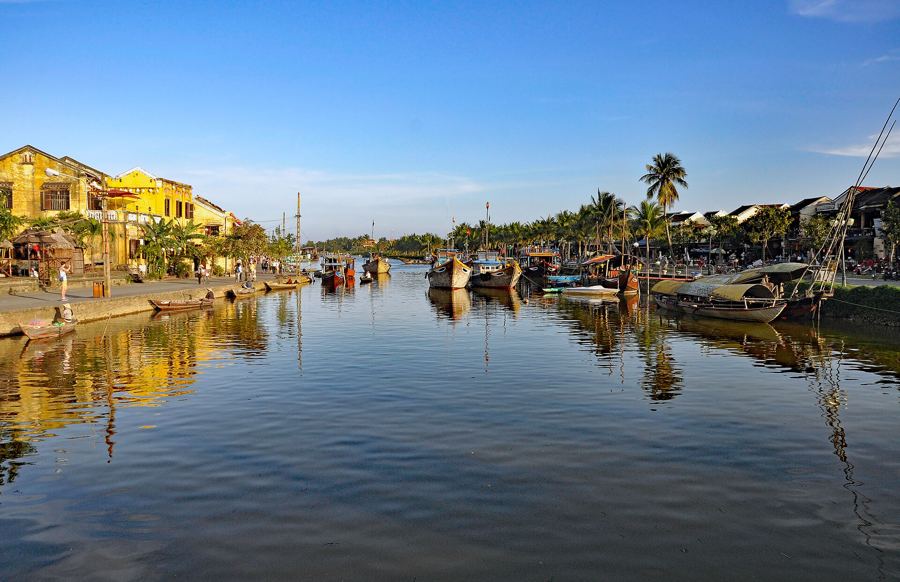 05:30The Thu Bon before the boats start
At this hour the dry-goods sellers are still unpacking. It is a good time to see how the stalls are built up from nothing: tarpaulins pulled back, plastic crates stacked into counters, scales set out. By the time most visitors walk through, it all looks as if it has always been there.
Breakfast on a stool
The food hall is the reason many people come, and with good reason. It is a long covered building with yellow columns and an open timber roof, lined on both sides with small cooking stalls. Each stall is a counter, a few pots and a burner, a cook, and a row of low plastic stools. Most stalls make one or two things and have been making them for years.

At six the food hall is mostly full of people from the town eating before work: market sellers, drivers, older men with a glass of iced tea. Breakfast here is noodles. You will see bowls of mi Quang, the province's own flat turmeric noodle with a little rich broth, peanuts and a toasted rice cracker; cao lau, the thick chewy noodle with slices of pork and crisp squares; and soups of various kinds. Rice dishes and sweet soups appear too.
The way to order is simple. Sit at a stall that is busy with locals, point at what the person next to you is eating, and hold up one finger. The cook will bring a bowl and a plate of greens. Tear the herbs into the bowl, add lime and chilli from the jars on the counter, stir, and eat. Pay when you leave. Prices are written on a board at some stalls and not at others, and they change; if there is no board, ask before you sit down.
Stalls in the food hall sometimes have touts at the entrance trying to steer visitors to one counter or another. You do not have to follow. Walk the length of the hall once, look at what is in the pots, and choose for yourself.
How to move through it
The market is small enough to cover in an hour and confusing enough to get pleasantly lost in. A good loop is the one this story follows: river first, while the fish is fresh; then the greens in the lanes; then the hall; and breakfast to finish. Carry small notes, keep your bag in front of you in the crowd, and let motorbikes pass, because some of them still squeeze down the lanes with deliveries.

Buy something. A bunch of herbs, a bag of fruit, a handful of fresh rice paper: it changes how you are seen, and it is the easiest way to start a conversation that needs no shared language. Bargaining for food is normal but gentle, and the margins on a bunch of greens are tiny. Do not haggle over small amounts.
Bring a reusable bag if you plan to buy, and expect your purchases to be weighed on a hand scale or a small dial scale and tipped straight into it. Fruit is a safe first buy: whatever is in season sits in pyramids near the hall, and a seller will usually let you choose. Peel or wash anything you eat raw. If you are staying somewhere with a kitchen, the market is also the cheapest way to stock it, and nobody minds a visitor buying three eggs and an onion.
If you only have time for one market visit, this is the hour. Later in the morning the produce is gone, the tour groups arrive, and the stalls near the entrance turn towards souvenirs and sunglasses.

At six the market is still doing what it is for, which is feeding the town.
After the market
When you come out, the shutters along Tran Phu are going up and the light is getting stronger. This is the moment to turn west and walk the length of the old main street before it fills, or to head across to the covered bridge while it is still quiet. Leave the bag of herbs with someone who can use it, or take the bananas with you. By the time you reach the bridge, the fish you saw landed will be in someone's pot.