
Half past eleven, and the Old Town is starting to empty. The heat has come up off the stone, the shopkeepers have pulled their chairs into the shade, and the people who were out at dawn are going home to eat. In the market food hall and at the noodle stalls along the lanes, the pots are hot and the stools are filling. This is the hour of cao lau.
Vietnamese lunch starts early, and for good reason. By noon the sun is nearly overhead, and in the hot months the streets are no place to be. A bowl of noodles in the shade, a glass of iced tea, and an hour of not moving: the town has organised itself around that idea for a long time.
What arrives in the bowl
Cao lau does not look like most Vietnamese noodle dishes. There is no deep broth. Instead the bowl holds a tangle of thick, flat, slightly yellow-brown noodles, with a few slices of pork laid across the top, a spoonful of dark, savoury sauce from the pork, and a pile of raw greens: lettuce, bean sprouts and herbs such as mint and basil. On top go squares of crisp fried dough, made from the same noodle dough, that crack between the teeth.

The noodle is the point. It is firmer and chewier than any rice noodle you have eaten elsewhere in Vietnam, almost springy, with a faint smoky, mineral taste. You turn the bowl over with chopsticks so the sauce coats everything, add chilli and a squeeze of lime if you want them, and eat it fast, while the crackers are still crisp.
The stories about the water and the ash
Every guide to Hoi An tells the same story about cao lau, and it is a good one. The noodles, the story goes, must be made with water drawn from one particular old well in the town, the Ba Le well, and the dough is treated with lye made from the ash of trees that grow on the Cham Islands, out at sea. That combination gives the noodle its colour and its bite, and so true cao lau can only be made in Hoi An.
How strictly this is followed today is hard to say, and it is best treated as tradition rather than a recipe. What is clear is that the alkaline treatment matters: like other lye-treated noodles around Asia, it gives cao lau its firm, chewy texture. And the noodles are said to be made by only a handful of families, which is part of why the dish rarely tastes the same when it is cooked elsewhere.

The pork and the greens
The pork is cooked in the morning, usually a cut with some fat on it, marinated with spices and seasoning and then roasted or braised until it is tender. It is sliced thin and laid over the noodles, and the juices from the pan become the sauce. The greens are not a side salad: they are part of the bowl, and they come from the vegetable gardens around the town. Mint, basil and lettuce cool the richness of the pork, and bean sprouts add a crunch of their own.
Where it came from
Nobody knows for certain. Hoi An was a port where Japanese, Chinese and European traders lived and worked between the 15th and 19th centuries, and people have long tried to fit the dish into that history. Some point to Japanese udon, because of the thick noodle; others to Chinese cooking, because of the roast pork and the sauce. One explanation for the name links it to eating in an upper room, but this too is uncertain.
The honest answer is that cao lau is a dish of the trading town, shaped by the people who passed through it, and that it has been Hoi An's own for as long as anyone can remember.
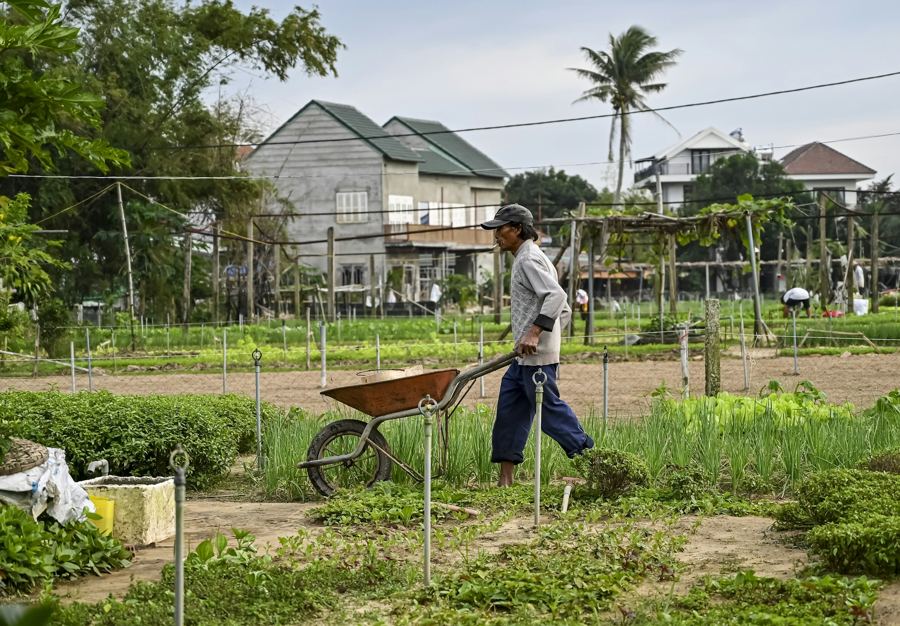 06:30Tra Que herb gardens at watering time
Cao lau and mi Quang
The other noodle you will meet everywhere in town is mi Quang, and the two are easy to confuse at first glance: both come with little broth, pork, greens and something crunchy. But they are different dishes. Mi Quang uses wide, soft, flat rice noodles, often tinted yellow with turmeric, with a little more broth, and it is usually topped with shrimp, pork or chicken, roasted peanuts and a broken sesame rice cracker. Cao lau has the thicker, chewier noodle, the crisp squares of fried dough and the dark pork sauce, and it rarely has peanuts.
The simplest test is the bite. If the noodle is soft and slippery, it is mi Quang. If you have to chew it, it is cao lau. Our page on mi Quang has the rest of the story.
Where and how to eat it
Cao lau is on almost every menu in the Old Town, but it is best at the places that make little else: the stalls in the food hall of the central market, and the small noodle shops in the lanes where a big pot of pork simmers by the door and the bowls are assembled to order. A good sign is a table of local people eating the same thing.

Ordering is easy. Sit down, hold up a finger and say "cao lau". The bowl comes with a plate of extra greens and a dish of chilli. There is no need to tip, and prices are usually written on a board or simply told to you; they change, so ask before you sit down if there is no board. Pay when you leave.
Some things to know. The pork is cooked earlier in the day and served warm, not hot. The crackers go soft if you wait. And the dish is small: a bowl of cao lau is a light lunch, which is why many people follow it with something else.
After the bowl
The stalls start to clear by one, and the town slows almost to a stop. If you are still hungry, the next step is a plate of com ga, the town's turmeric chicken rice, which is at its best in the same midday hour. Otherwise, find a seat in the shade, order an iced tea and let the heat pass. The lanes will wake up again at three.