
At three in the afternoon the heat is past its worst but has not let go. The tiles on the shophouse roofs are still giving it back, and the Old Town moves at the pace of people looking for shade. Inside the silk shops the fans turn slowly over racks of scarves, bolts lean against the walls, and the light from the doorway catches the cloth at a low angle. That low light is useful. Silk shows what it is when it moves in the light, and the late-afternoon sun gives it a chance to.
It is also the hour when shops are empty enough to let you handle things without a crowd at your elbow. By six the same rooms will be full, the lanterns will be on, and nobody will have time to explain how a cocoon becomes a thread.
The cargo that built the port
Hoi An was a trading port from the fifteenth to the nineteenth century, a place where Japanese, Chinese and European merchants came to buy and sell. Silk was near the centre of that trade. In the early seventeenth century, Japanese ships came south on the monsoon winds and loaded raw silk and silk cloth here, along with sugar and other goods. Chinese merchants bought and sold silk too, and the town's Chinese assembly halls still stand a few streets from the river.
The trade shaped the town you walk through now. The long, narrow shophouses on Tran Phu and Nguyen Thai Hoc were built for merchants who lived above, behind or beside their goods, with a shop at the street end and a store at the back running down towards the water. Read our piece on the merchant houses to see how those buildings worked. Then the river silted up, the big ships could no longer reach the town, and trade moved north to Da Nang. Silk stayed, but as a craft and a shop counter rather than as a ship's cargo.

Mulberry on the river banks
Silk begins with a leaf. The domestic silkworm eats almost nothing but mulberry, so the history of silk in Quang Nam is also the history of mulberry fields. The province's rivers lay down fine silt on their banks and sandbars every flood season, and those low, fertile banks along the Thu Bon were where mulberry was grown. Upstream, in Duy Xuyen district, the village of Ma Chau has been known for silk weaving for a very long time, and its name still comes up whenever Quang Nam silk is discussed.
The cycle is short and hungry. Eggs hatch into tiny larvae that eat fresh leaves day and night, moulting several times and growing enormously in a few weeks. Leaves must be picked and brought in constantly. When a worm is ready, it stops eating, lifts its head and begins to spin, wrapping itself in a single continuous thread. A cocoon is one filament, often several hundred metres long, laid down in a figure-of-eight over a few days.
A cocoon is one filament, often several hundred metres long, laid down in a figure-of-eight over a few days.

From cocoon to thread to cloth
To get the filament off the cocoon whole, the cocoon is softened in hot water, which loosens the gum that holds the thread together. A reeler finds the loose ends of several cocoons at once and draws them together into one thread, because a single filament is far too fine to weave with. The more filaments twisted together, the heavier the yarn.
The reeled yarn is then washed, sometimes dyed, and wound onto bobbins for the loom. A plain-weave silk passes one weft thread over and under the warp, row after row. Patterned silks need more complicated looms that lift different warp threads in sequence, and they are slow work. Watching a loom for a few minutes explains a lot about price: every centimetre of the cloth is hundreds of passes of the shuttle.
Elsewhere in Vietnam, highland communities weave brocade on backstrap looms, with the warp held taut by the weaver's own body. It is a different tradition from lowland silk, but the principle is the same, and the patience is the same.

 17:30Lantern making
How to tell silk from polyester
Most of the scarves hanging in the Old Town are not silk, whatever the sign above them says. That is not a scandal, just the market: polyester is cheap, holds bright dyes, and looks fine from a metre away. The point is to pay silk prices only for silk.
Start with touch. Real silk feels smooth but not slippery, and it warms quickly in the hand. Polyester tends to stay cool and has a slight plastic slickness. Rub a fold of the cloth between thumb and finger: silk makes a faint dry rustle, sometimes called scroop. Crush a corner in your fist and let go. Silk creases softly and the creases relax. Many synthetics spring back unmarked or hold sharp lines.
Look at the sheen. Silk has a soft lustre that changes colour slightly as you move it in the light, because the triangular cross-section of the fibre reflects light at different angles. Polyester shines more evenly, with a flat white glare.
The surest test is the burn test, and many sellers will do it for you on a loose thread or a cutting. Real silk burns slowly, curls away from the flame, smells of burnt hair, and leaves a dark ash that crumbles to powder between your fingers. Polyester melts and drips, smells chemical, and leaves a hard bead that will not crush. Do not ask to burn a garment. Ask to burn a thread from the bolt or an offcut.

Buying, and what silk is good for here
Silk is one of the cloths the town's tailors will cut for you, though for most clothes in this climate cotton or linen is more practical. Silk shirts and dresses are lovely and cool, but they mark with sweat and want hand-washing. A silk scarf, a length of plain silk to take home, or a lined silk jacket are the safer buys. Our guide to getting something made covers fittings, and shopping without regret covers bargaining and shipping.
Ask what the silk is, where it was woven, and how it should be washed. Ask to see the full bolt, not just the folded piece on the table. Prices vary with weight, weave and origin, and they change, so we give none. A seller who is happy to pull a thread and light it in front of you is usually a seller who knows what they are selling.
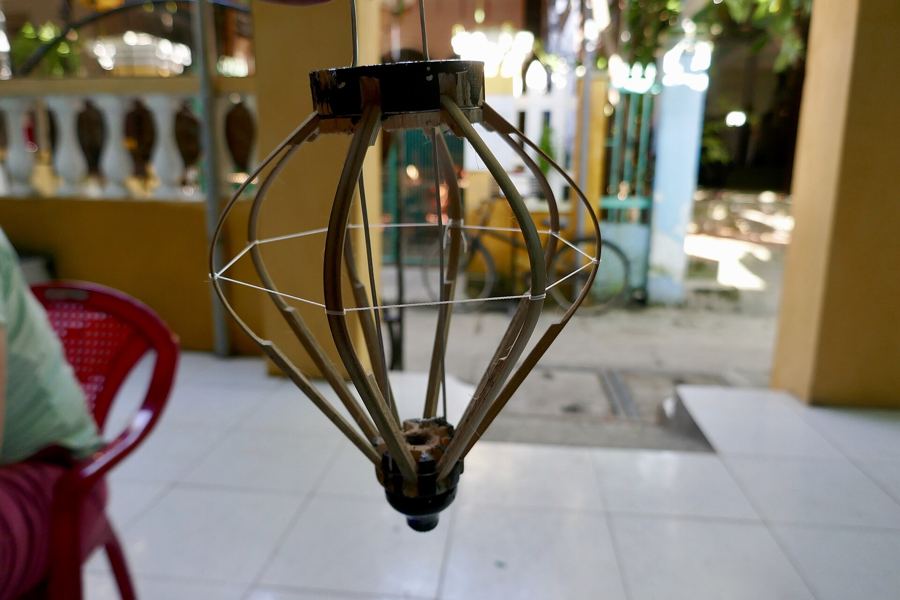
Silk also turns up in places you might not expect. The panels stretched over the bamboo ribs of Hoi An's lanterns are often silk, and the lantern makers who work in the late afternoon are cutting and gluing the same cloth you have been rubbing between your fingers.

When the light goes
By half past four the sun is low enough to reach under the awnings, and the bolts in the doorways glow. This is the best moment to judge colour, so if you are choosing a cloth, carry it to the street now rather than later under the lamps. An hour from now the lanterns come on, the light becomes yellow and forgiving, and every scarf on every rail looks like silk.
If you have bought something, take it back to your room before the evening crowds. Fold it in tissue or a cotton bag rather than plastic, keep it out of the sun, and wash it later by hand in cool water. Silk has crossed oceans from this riverbank for four hundred years. It will survive a suitcase, as long as nobody packs it wet.