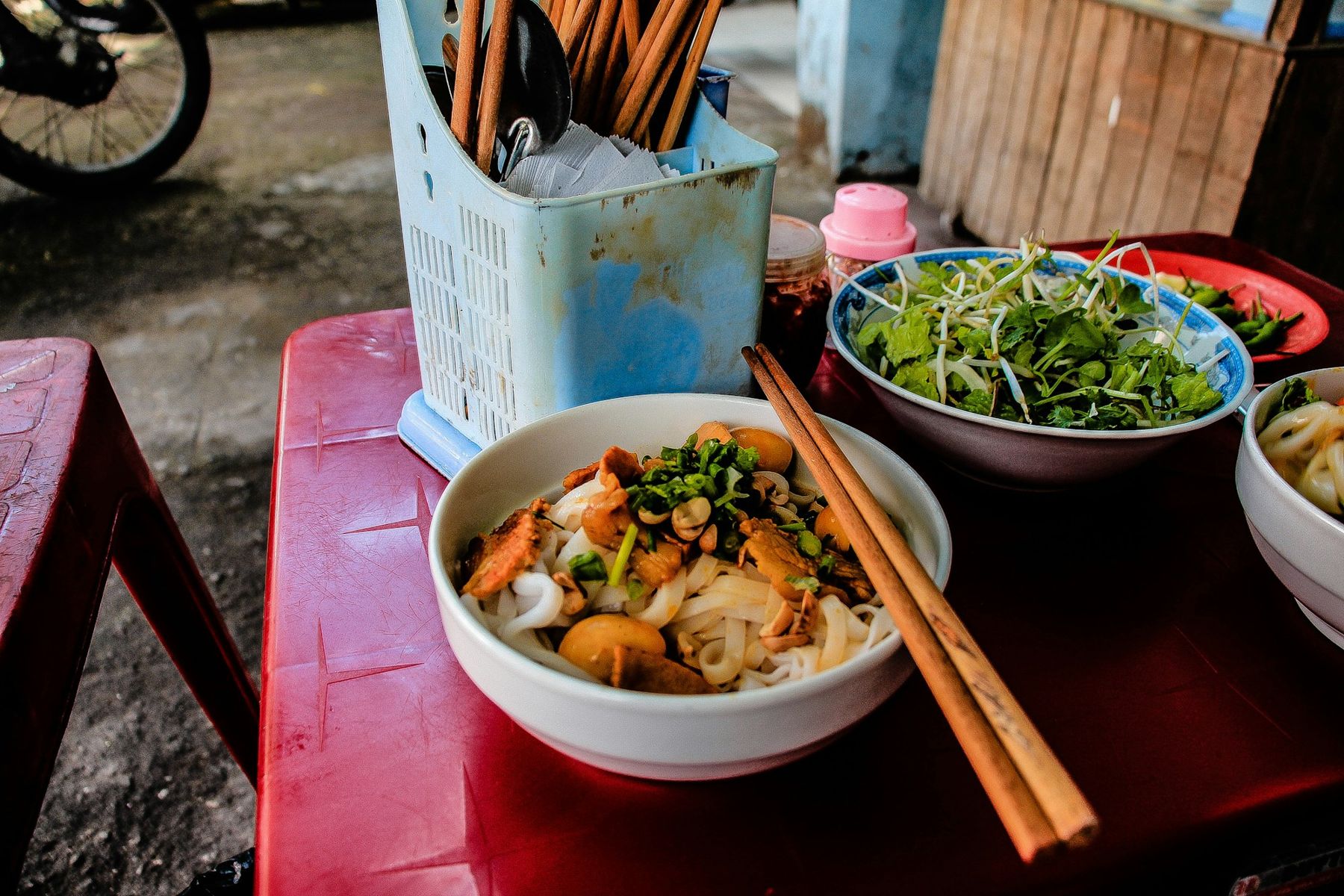
At nine o'clock the town changes shift. The lantern boats are tying up for the night, the families from Da Nang are heading back up the road, and the river crowd is breaking into small groups looking for something to eat. On the pavements, low plastic stools and tables appear around pots of broth and charcoal grills. A woman fans the coals under a row of skewers. A man ladles soup from a pot that has been simmering since the afternoon. The light is a single bulb hanging over each stall, and the smell is smoke, fish sauce and lemongrass.
This is the best hour for street food in Hoi An. The daytime heat has gone, the stalls that cater to the late crowd are at full speed, and you can sit for as long as you like. Below are the questions people ask most often before they sit down.
Why eat at this hour?
Because the food is at its best when the stall is busy. A busy stall turns its food over quickly, so what you eat has just been cooked. At nine the evening stalls have their regulars, the broth has had all day to develop, and the grill is hot. Earlier, the stalls are still setting up; much later, many are packing away and what is left has been sitting.
It is also cooler. Eating soup on a pavement at noon in central Vietnam is hard work. At nine at night, with a breeze off the river, it is a pleasure.
How does a stall work?
Most stalls do one thing, or a few closely related things. A stall with a big pot of broth sells one kind of noodle soup. A stall with a grill sells grilled meat with rice or bread. A cart with glass cases sells banh mi. The dish is the menu, and there may be no written menu at all.
Sit down on a stool. Someone will come over, or the cook will catch your eye. Point at the pot, or at what the people next to you are eating, and hold up the number of fingers for the number of bowls. That is all it takes. Cutlery, napkins and sauces are usually on the table already: chopsticks and spoons in a box, a jar of chilli, fish sauce and perhaps a bottle of soy. Some people wipe their chopsticks and spoon with a napkin before using them, out of habit; you can do the same.
If you want to try the dishes Hoi An is known for, look for cao lau and white rose dumplings in the evening, and banh mi at almost any hour.
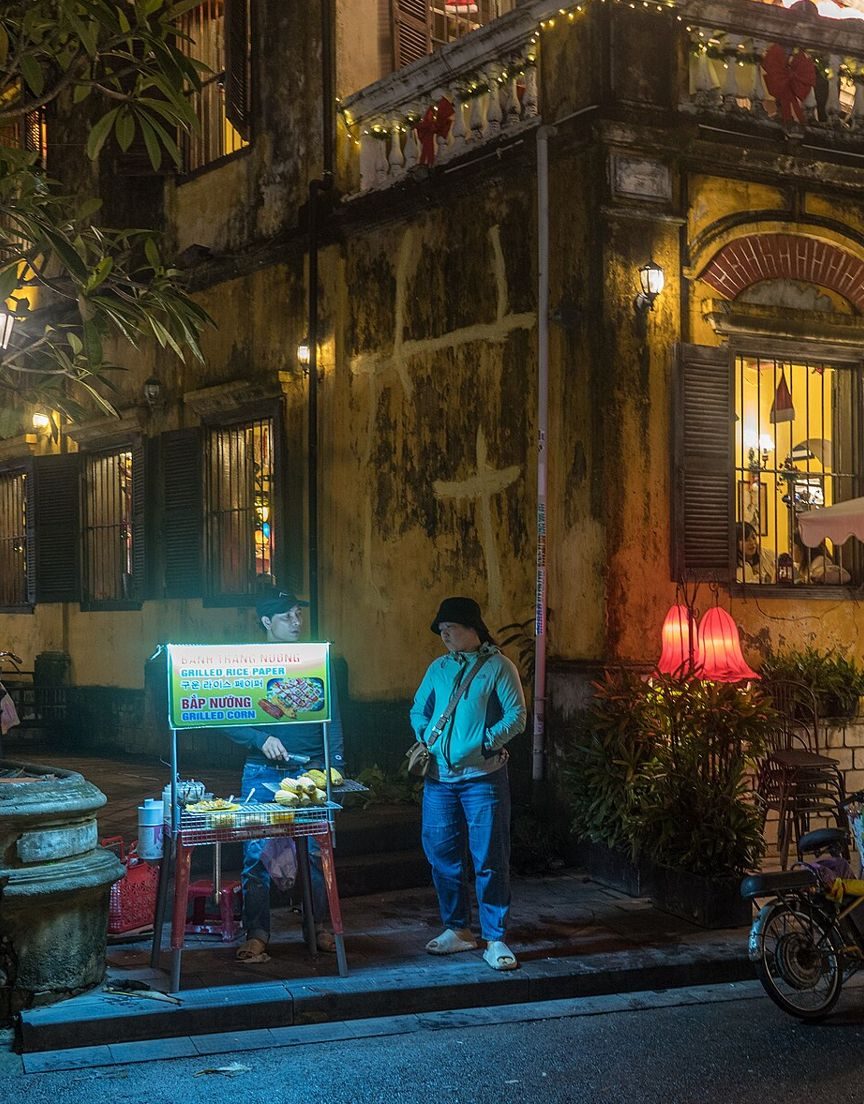
Do you need to speak Vietnamese?
No, though a few words help and are always welcomed. "Cai nay" means "this one", useful with a pointing finger. "Mot" is one, "hai" two, "ba" three. "Khong cay" means not spicy. "Bao nhieu tien?" asks how much. "Cam on" is thank you. Say it with a smile, and pronunciation will be forgiven.
How do you know the price?
At most stalls there is no price list. Ask before you eat, either with "Bao nhieu tien?" or by pointing and raising your eyebrows; the cook will tell you or show you on a phone or calculator. Street food is cheap compared with restaurants, but prices vary by stall and change over time, so we give none here.
Pay at the end, in cash, in small notes. Tipping is not expected at stalls. If you are charged more than seems right, ask again politely. Mistakes happen both ways, and a smile settles most of them.
 12:00Com ga, the town's chicken rice
Is it safe to eat?
Generally, yes, if you use a little sense. Choose stalls that are busy, especially with local customers; they would not keep coming back otherwise. Eat food that is cooked in front of you and served hot. Look at how the stall is kept: clean surfaces, food covered, raw and cooked kept apart. Be more careful with dishes that have sat out at room temperature, and with shellfish.
Ice in drinks is usually made in factories and delivered in bags, and most visitors have no trouble with it. If your stomach is cautious, ask for drinks without ice. Carry hand sanitiser or wash your hands before eating. And in your first days, introduce your stomach to new food gradually rather than eating everything on the first night.
What about the herbs on the side?
Many dishes come with a plate of raw herbs and greens, rau song, on the side: mint, basil, perilla, lettuce, bean sprouts and others, often with lime wedges and sliced chilli. Tear the herbs into your bowl as you go, a few at a time, so they stay fresh. They are a big part of the flavour, and they are what makes the food taste of this region.
The herbs are washed in tap water, and they are raw. Most visitors eat them without trouble, but if you are worried, or your stomach is already unsettled, leave them aside for a day or two.
What should you drink?
The default is tra da, iced tea, weak and refreshing, often free or very cheap and refilled without your asking. Nuoc mia, sugarcane juice pressed through a roller while you wait, often with a squeeze of kumquat or lime, is sweet and very cold. Fresh coconut is easy to find in the evenings. And there is always beer, usually a local lager served with a glass of ice. Avoid tap water; bottled water is everywhere.
When do the stalls set up and pack down?
Every stall has its own rhythm. Some sell only in the morning, some only at lunch, some only in the evening, and the same corner can host three different stalls across one day. Evening stalls start setting up in the late afternoon and are busiest from dusk until about ten. Later, they begin to pack away, and by eleven many are gone. Hours vary and change, so if a stall you liked is not there, try again the next evening.
In the wet season, roughly October to December, some stalls close on bad nights, and those that stay open set up under awnings and tarpaulins. In heavy rain the late-night scene is thin.
What is the etiquette?
Share tables when it is busy; it is normal to sit next to strangers. Do not linger too long when people are waiting for a seat. Leave napkins and bones on the table or in the bin provided; at some stalls the floor is where they go, but follow what others do. Speak quietly late at night, when the people living above the stalls are trying to sleep.
Where does the night go from here?
By half past ten the stools are being stacked and the river is dark and quiet. Walk back through the Old Town streets, now almost empty, and listen to the shutters coming down. Get some sleep. The next good meal is in the morning, at the market at opening, when the town starts all over again.