
At a quarter to seven Tran Phu is a long, quiet street of closed wooden doors. The lanterns strung overhead are off. A shopkeeper rinses the step in front of her house with a bucket and the water runs into the gutter. Two older men sit on plastic stools with glasses of coffee and do not look up. A bicycle ticks past. That is almost all the traffic there is.
Tran Phu is the old main street of Hoi An, running east to west, parallel to the river, from the central market to the covered bridge. Most of the houses along it are tube houses, narrow at the front and very deep, built for merchants who traded through the front room and lived further back. Many still have their dark timber fronts, tiled roofs and ochre walls. One block south, Nguyen Thai Hoc runs the same way, closer to the water.
This walk goes the length of Tran Phu from east to west in the early light, then turns and comes back along Nguyen Thai Hoc to the river. It is short, about a kilometre and a half in all, and the point is not to see inside anything. The point is to see the street itself before the shutters go up and it becomes a shop window. Ticketed sights open later; for those, see how the ticket works.
Central market corner
Start at the east end, where Tran Phu meets the market. This is the one corner of the Old Town already busy at dawn. Motorbikes pull up with baskets, fish comes off the boats behind the market hall, and the noodle cooks have their pots on. If you came from the market, you will be carrying the smell of it with you.
Turn your back on the noise and look west along Tran Phu. The street runs dead straight between two rows of low houses, and at this hour you can see a long way down it. The sun is behind you, so the light falls along the street and catches the upper floors first.
Quan Cong temple
A few steps along on the right is the Quan Cong temple, with red-lacquered doors and a courtyard behind them. It is dedicated to Quan Cong, the general from Chinese history known elsewhere as Guan Yu, who is honoured for loyalty and integrity. Inside, when it is open, there is a large statue of the general with a red face.

At this hour the doors may still be closed. Stop anyway and look at the roofline: the green glazed tiles, the curled ends, the small ceramic figures. The same vocabulary appears all along the street, on the assembly halls built by the Chinese merchant communities that settled here when the town was a port.
Phuc Kien assembly hall gate
Further along, on the right, a tall ornate gate stands back from the street. Behind it is the assembly hall of the Fujian community, the largest of the Chinese groups that settled in Hoi An, and dedicated to Thien Hau, the goddess who protects sailors. The gate is the most photographed in the town, and early is the only time you will have it to yourself.
Even if the hall is shut, the gate and the garden glimpsed behind it are worth a pause. The halls along this street are covered in more detail in the assembly halls walk, which starts a little later in the morning when the doors are open.

Quan Thang house
Keep walking west. Between the halls, Tran Phu is a run of merchant houses, most now shops with living quarters behind and above. At the Quan Thang house, one of the oldest on the street, the depth of these buildings is clear: the house runs from Tran Phu right through to Nguyen Thai Hoc, with a small open courtyard in the middle to bring in light and air.
Look at the fronts as you go. Many have the same pattern: removable wooden panels across the whole width, slotted into grooves top and bottom, so the shop can be opened wide in the day and closed at night. At this hour many are still in place, and you can see the street as the shopkeepers do, as a line of closed boxes about to open.
 08:30Old merchant houses you can enter

Listen too. There is usually a radio somewhere, and the sound of a broom, and a rooster that has not yet given up. By eight these sounds are covered by music from the shops and the voices of visitors.
The covered bridge
Tran Phu ends at the covered bridge, Chua Cau, which crosses a small stream running down to the river. This is the turning point of the walk. The bridge is traditionally dated to the 1590s and attributed to the Japanese community, and it was restored in 2023 and 2024. At seven there may be a handful of photographers and almost no one else.
Walk to the bridge, look at the carved roof and the small temple on its north side, and decide whether to cross now or come back later. The story of the bridge is told in full at its own hour.
Tan Ky house
From the bridge, take the short way down towards the river and turn east onto Nguyen Thai Hoc. This street is wider and closer to the water, and its houses were built with a front on the street and a back on the river, so goods could come in by boat and go out through the shop.

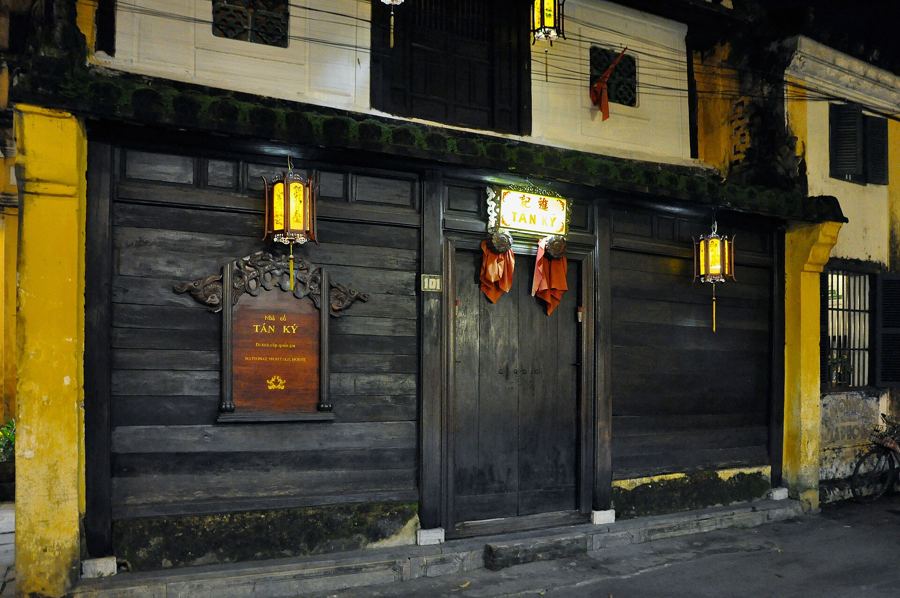
The Tan Ky house is the best known of these. Its dark timber front faces Nguyen Thai Hoc; its back opens towards Bach Dang and the Thu Bon. Inside, which you can see later with a ticket, there is fine joinery and carving and marks on the wall showing how high the floods have come. From outside, at this hour, it is just a dark wooden front with lanterns and a closed door, and that is what most of the town looked like for most of its history.
As you walk east, notice how the light changes. The sun is now in front of you and low, so the street is half in shade, and the yellow walls on the north side are bright.
Bach Dang quay
At the end of Nguyen Thai Hoc, turn down to the river and finish on the quay along Bach Dang. By now the boats from the upper river and the islands have mostly unloaded, the fish landing behind the market is at its peak, and the first boatmen are waiting for passengers.

Look back across the water at the houses you just passed. From the river you can see what the street hides: the backs of the merchant houses, built to open onto the water, and the line of roofs running unbroken from the market to the bridge. This is the view the traders had when they arrived.
Before the shutters go up
The whole walk takes about an hour at a slow pace, and you could do it in half that. Start no later than seven. By half past, the shutters are up along most of Tran Phu, the first tour groups have reached the covered bridge, and the street begins its day as a long shop.
There is no need to buy anything or go inside anything on this walk. Bring water, wear shoes you can walk in, and let the street do the work. If you want coffee, the stools by the market are already full and the cooks there will make room. Then, when the doors start to open, go back to the bridge.