
By half past ten the carpenters of Kim Bong have been at their benches for hours, and the rhythm of the village is set: the tap of a mallet on a chisel, the rasp of a hand saw, a radio somewhere playing to nobody. The sun is high over the lanes but the workshops are deep and open-fronted, and in their shade it is cooler than on the river road outside.
Kim Bong lies on Cam Kim island, just across the Thu Bon from the Old Town. Most visitors come over by ferry or bridge as part of a bicycle ride round Cam Kim, but the village deserves its own hour. This is where the timber of the old trading port was shaped.

The town's builders
When Hoi An was a busy port, between the 15th and 19th centuries, its merchants built in wood. The long tube houses along Tran Phu and Nguyen Thai Hoc, the assembly halls and the temples all rest on timber frames, and the skills to build them were concentrated in a few villages nearby. Kim Bong was one of the most important. Its carpenters cut the beams, carved the panels and fitted the doors, and they came back, generation after generation, to repair them after floods and termites.
The village's reputation reached beyond Hoi An. Tradition holds that Kim Bong craftsmen also worked on buildings for the Nguyen court in Hue. It is a story the village tells with pride.
Joinery without nails
The heart of the craft is joinery. A traditional Hoi An house frame is held together by mortise and tenon joints, cut so that one piece of timber slots into another, and locked with wooden pegs. There are no nails. A frame built this way can flex a little in a storm, and it can be taken apart and reassembled, which is how old houses have been moved or rebuilt over the centuries.
In the workshops you can see the same principle at a smaller scale: chairs, altar tables and cabinets assembled dry before they are glued or pegged, the joints so tight that a piece can be lifted by one leg. The carpenters work largely with hand tools, with power saws used for the rough cutting.
The wood itself
The old houses of Hoi An were built from tropical hardwoods, chosen because they are dense, strong and slow to rot in a town that floods almost every year. Good timber has always been the expensive part of the job, and carpenters here talk about wood the way cooks talk about fish: where it came from, how old it is, whether it has been dried properly. Timber that is not seasoned slowly will twist and split once it is in a frame.
In the workshops you will see the results of that care. Offcuts are kept and reused, old beams from demolished buildings are cut down for new work, and sawdust is swept up for fuel. The smell of each wood is different, and some of it is strong enough to notice from the lane.
Reading a frame in town
Once you have seen a Kim Bong workshop, the old houses in town become easier to read. Stand inside a merchant house and look up. The roof rests on columns, and the columns carry beams that are joined, not nailed. The beams are often shaped and carved where they meet, and the brackets that carry the roof purlins are cut into curves or animal forms. The quality of the joinery is part of why these houses have survived centuries of floods: water comes in, the wood swells, the water goes, and the frame holds.
The same eye for joints works on furniture in the houses: the heavy altar tables, the carved screens that divide the front room from the back, and the doors that fold back to open the house to the street.
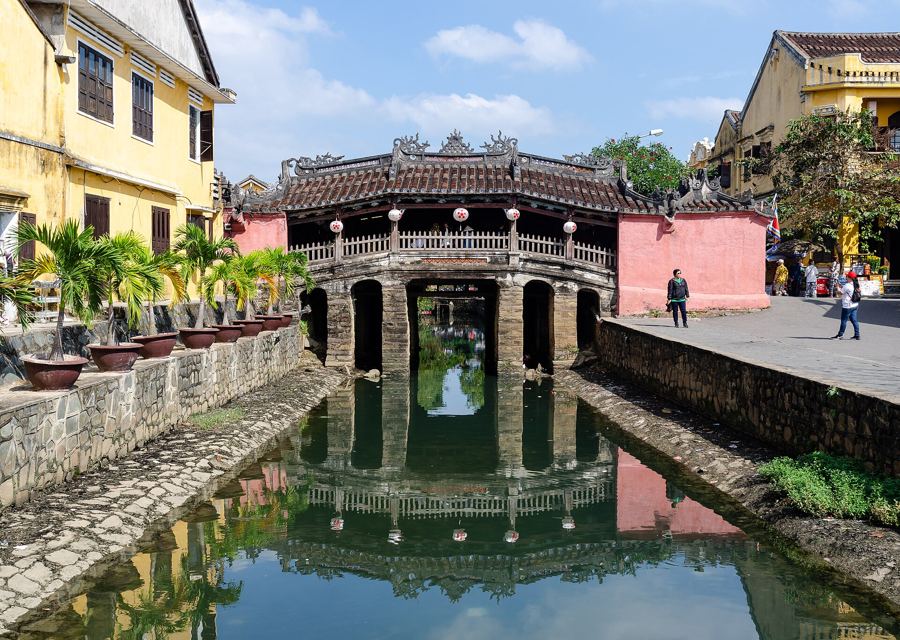 07:00The covered bridge, before and after the restoration
Carving
Carving is the part most visitors stop to watch. Look up in any of the old merchant houses in town and you will see it: carved brackets under the roof beams, panels of birds and flowers, fish and dragons, and above many doorways a pair of carved wooden "eyes" that are said to watch over the house. In Kim Bong the same motifs are cut by carvers working on panels laid across benches, or on smaller pieces held between the feet.
A design is drawn onto the wood first, then roughed out with a mallet and broad chisels. The detail comes from a set of fine gouges, each a different curve, worked in short strokes. A large panel can take weeks. Watch for long enough and you will see how little wood is wasted and how often the carver stops to look.
Some workshops sell what they make, from chopsticks and small boxes to large carved panels. Small pieces travel well; heavy furniture involves shipping that costs more and takes longer than people expect, so get every detail in writing before agreeing to it.
The boats
Kim Bong also builds boats, and the boatyards on the island's riverbank are part of the same tradition. Wooden boats for the river and for fishing along the coast are still built here, frame first and then planked. The hulls rise on the bank over weeks, propped on timber, and when they are ready they are slid into the Thu Bon.
The boats you see on the river in town, ferrying people to An Hoi or taking visitors out at dusk, are often from these yards or repaired in them. Look at the bow and you may see a pair of painted eyes, the same idea as the carved eyes over a house door.

Visiting
There is no single entrance or ticket for the village. You simply walk or cycle its lanes and stop where something is happening. Workshops are workplaces; most people are happy to be watched for a few minutes, but ask before taking close photographs, and keep clear of saws and chisels. If there is a demonstration area or a training workshop open to visitors, it will be signposted.

Rain is not a problem here: the workshops are covered, and a wet morning is often a good time to find carvers at their benches rather than out on deliveries. In the flood months, roughly October to December, check whether the crossing is running before you set out.
By noon, the light on the river is white and the carpenters break for lunch. Take the ferry or the bridge back to town and follow their lead: the Old Town's lunch hour belongs to com ga and noodles, eaten in the shade.