
At three o'clock the sun is still high over Hoi An and the streets of the Old Town are slow and hot. It does not feel like the moment to get on a bicycle. It is, though. Cam Thanh lies a few kilometres east of the Old Town, where the Thu Bon spreads out towards the sea and the water turns brackish, and by the time you reach it the worst of the heat will have passed. The palms throw long shade over the channels in the late afternoon, and the light that comes through them is green and gold rather than white.
Go at nine in the morning and you meet the tour buses. Go at three and many of them have gone, the water is calmer, and you come back into town just as the lanterns are lit.
The ride out
The road east from the Old Town runs out past the edge of town and into flat, open country of rice paddies, shrimp ponds and low houses, with the river never far away on your right. It is flat all the way, and on a bicycle the trip takes about twenty-five minutes at an easy pace. Most places to stay lend or rent bicycles, and our guide to getting around covers the options if you would rather go by taxi or motorbike.
The air changes as you go. It gets wider and saltier, and the paddies give way to water and mud flats where herons stand in the shallows. Then the first clumps of water coconut appear along the banks, their fronds rising straight out of the water like enormous feathers.
What the water coconut is
The water coconut, dua nuoc in Vietnamese, is a palm without a proper trunk. It grows in brackish water at river mouths, its roots in the mud and its fronds shooting up from just above the waterline. At Cam Thanh it covers a wide stretch of the estuary, cut through by narrow channels just wide enough for a small boat. The fronds have long been used for thatching roofs and walls, and the palms hold the muddy banks together against tides and floods.
The area is often called Bay Mau, after the stretch of palms best known to visitors. For the people who live here it is working water: there are fishing nets on poles, crab traps in the mud, and small boats tied up at the edges of the houses. The palm channels are a place people make a living, not a set built for visitors, even if the busiest landings now look a little like one.
The thung chai
The round basket boat, the thung chai, is one of the oldest boat shapes on the central coast. It is woven from split bamboo into a deep bowl, braced with a bamboo rim, and coated with a dark waterproof layer so that it floats. Fishermen still use them all along the coast to get from the beach to the larger boats moored offshore, and you will see them stacked on the sand at An Bang and Cua Dai.
A round boat does not steer the way a canoe does. It is moved with a single paddle worked at the front in a sculling figure-of-eight, which pulls the boat along without the paddle ever leaving the water. In skilled hands it goes surprisingly straight. In unskilled hands it goes round and round, which is where the show comes from.

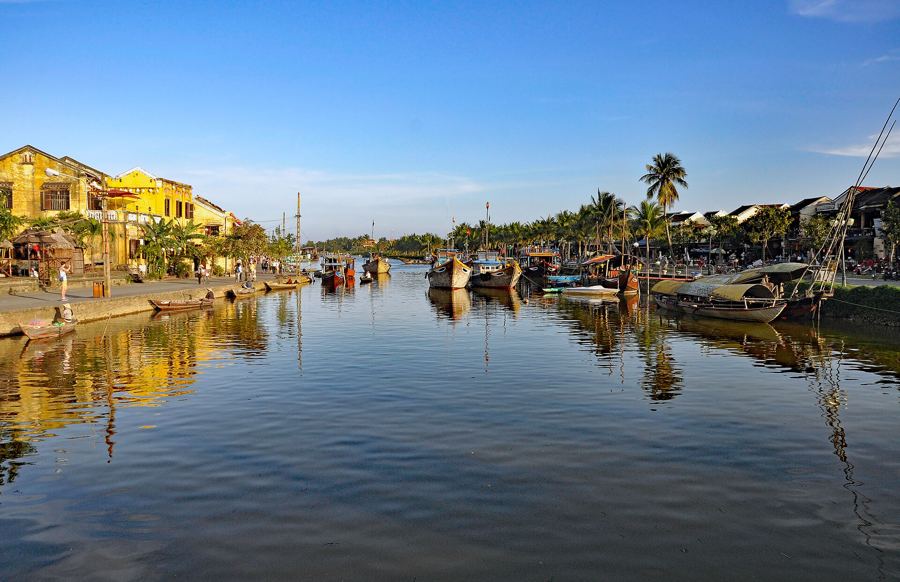 05:30The Thu Bon before the boats start
The spinning show, and the quieter way
At the busiest landings, a trip into the palms has become a performance. Loudspeakers play music across the water, boatmen spin their baskets in fast circles for passengers to film, and a cluster of boats gathers in one wide pool to watch. Some people love it. It is cheerful, it is noisy, and the boatmen who do it are very good at it.
If you want something else, it is easy to ask for. When you agree the trip, say you would like a quiet ride through the smaller channels, with no spinning and no stop at the music. Ask how long the trip will be and agree the price before you get in. Prices are set at the landing and they change, so we give none. Smaller landings further along the road are often quieter than the first one you come to.
On a quiet ride the boatman threads the basket into channels barely wider than the boat, and the fronds close over your head. You hear the paddle, a few birds, and the slap of small waves on the bamboo. Crabs scuttle into holes in the mud. Sometimes you pass someone mending a net, or a fisherman standing waist deep. Many boatmen fold a frond into a ring or a small grasshopper and hand it to you, which is a nicer souvenir than anything in the shops.
Things to know before you go
The level of the water changes with the tide. At low tide some channels are shallow and muddy, and the trip may be shorter. In the flood season, roughly October to December, the river can run high and brown, and boat trips may stop altogether on bad days. On those days, leave it for another visit.
Bring a hat, water and sun cream. The basket is open and there is little shade until you are deep in the palms. Wear clothes you do not mind getting splashed, and keep your phone in a bag; a phone dropped over the side of a thung chai is gone. Life jackets are usually offered. Wear one.
Cash is the norm at the landings, in small notes. Agree everything before you push off, including whether the price is per boat or per person, and whether the boatman expects a tip at the end. It is a short trip, and a clear start keeps it a pleasant one.
If you like the countryside on two wheels, the morning ride through Cam Kim makes a good pair with this one, on the other side of the river.

Riding back as the light goes
By half past four the sun is low over the paddies behind you. From the landing you can keep going east to the sea at Cua Dai, ten minutes further on, and watch the fishing boats come in, or turn back towards town. The ride back is the best part of the afternoon. The light is long and level, the water in the shrimp ponds turns copper, and the road fills with children cycling home from school and farmers coming in from the fields.
You reach the edge of the Old Town at about half past five, as the first lanterns flicker on along the river. Leave the bicycle, wash off the mud, and the evening is ahead of you.