
At half past seven Tran Phu is waking. The shutters are coming down off the shop fronts, the first cyclos are parked at the corners, and the light, still low from the east, runs straight along the street. Behind the tall gates on the north side, caretakers are sweeping courtyards, lighting the first incense and opening the heavy doors of the halls.
These are the assembly halls, called hoi quan in Vietnamese. When Hoi An was a trading port, Chinese merchants came here from different provinces of southern China and settled. Each community built a hall: a meeting place, a temple, a guild house and a place to help members who arrived with nothing. They were funded by the merchants and rebuilt as the communities prospered, and most of what you see today dates from rebuilding in the 18th and 19th centuries.
This walk runs from west to east along Tran Phu, then ends a short way beyond it on Nguyen Duy Hieu. It is under a kilometre. Several of the halls take a coupon from the Old Town ticket, and opening times vary; see how the ticket works before you set out. In each hall, remove your hat at the altar, keep your voice down and do not point your feet at the shrines.
Cantonese assembly hall
Start near the covered bridge, at the hall of the Cantonese community, a short way east along Tran Phu on the north side. It is one of the most decorative halls and one of the first to fill, so begin here while it is quiet.

Inside the gate is a courtyard with a fountain in the form of a dragon, its scales built up in ceramic. Behind it the main hall is dedicated to Quan Cong, the general from Chinese history honoured for loyalty, a fitting patron for a community of traders who relied on keeping their word. Look up at the roof beams and the carved brackets that hold them, and at the panels of figures from old stories set into the walls.
At the back there is often a quieter garden. Take a minute there before moving on.
Chinese All-Community hall
Walk east along Tran Phu. On the north side is the hall shared by the town's Chinese communities together, a reminder that the groups also worked as one when they needed to.
It is plainer than the others and often has the fewest visitors, which is a reason to go in. The courtyard is calm and the main hall has an altar to Thien Hau, the sea goddess who is honoured in several of the halls. Look at how the space is arranged: gate, courtyard, hall, altar, in a line from the street. The same pattern repeats in every hall on this walk, and once you see it, you will read the others faster.

Phuc Kien assembly hall
A few doors further on is the largest and best known of the halls, built by the community from Fujian, the largest Chinese group in Hoi An. Its tall triple gate, covered in green glazed tiles and ornament, stands back from the street behind a small garden. If you walked Tran Phu at dawn, you saw this gate shut.
Inside, the hall runs back through courtyards and pavilions. The main altar is to Thien Hau, the goddess who protects sailors and ships, which tells you what mattered to a community that arrived by sea and traded by sea. Further back are altars to other deities, including figures to whom people pray for children, and the courtyards are planted with bonsai and flowering trees.
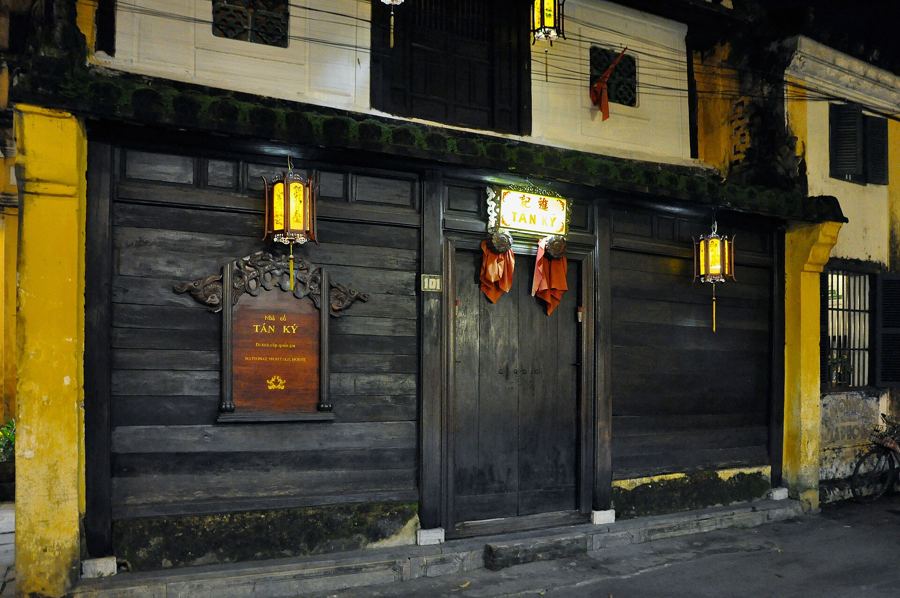 08:30Old merchant houses you can enter
Look up at the large spirals of incense hanging from the roof. They burn for days or weeks, and each one carries a slip of paper with a prayer and a family's name. In the morning light, the smoke curls through the beams and hangs in the courtyard in blue layers.
Quan Cong temple
Keep going east to the end of Tran Phu where it meets the market. On the north side, opposite the market, is the Quan Cong temple. It is not an assembly hall but a temple to the same general honoured in the Cantonese hall.
The red doors open onto a courtyard. The main hall holds a large statue of the general with his red face and long beard, flanked by attendants. People come here to ask for help with business and with disputes. It is a working temple, so step aside for anyone praying.

Hainan assembly hall
Near the eastern end of Tran Phu stands the hall of the Hainan community. Its story is darker than the others. The hall commemorates a large group of Hainanese merchants killed in the middle of the 19th century after being mistaken for pirates. They were later recognised as innocent, and the hall was built in their memory.
It is a quiet place, with a courtyard, a main hall and carved and gilded altar panels. Fewer visitors come here, and it has the feel of a memorial more than a showpiece. Stand at the altar a moment and read the hall for what it is.

Trieu Chau assembly hall
From the end of Tran Phu, continue east along Nguyen Duy Hieu for a few minutes to the last hall on this walk, built by the community from Chaozhou. Its patron is a general believed to calm the sea and protect boats, another sign of what these merchants feared most.
The Chaozhou hall is famous for its wood carving. Look closely at the altar and the doors: dense scenes of figures, animals, birds and flowers cut in deep relief, and ceramic decoration on the roof ridges. It is the most detailed work on the walk, and the hall is usually less crowded than the ones on Tran Phu.

After the halls
By the time you leave the Trieu Chau hall it will be after nine. The sun is up, the street is warm and the groups have reached Tran Phu. The halls you walked through in quiet will now have guides and loudspeakers. That is the reason for the early start.
Walk back towards the centre and spend the next hour in the old merchant houses, where the same merchant families lived and traded. In the halls you saw the communities in public, at worship and in council; in the houses you see them at home. Between them, the two tell most of what Hoi An was. Then, when the heat comes up around eleven, it is time to find a bowl of noodles in the shade.